


What's the Key Dj tip
Extracted from the Multi-Racial UMI Advance Dj course...
Mixing in musical key/Harmonic Mixing is something that lots of DJs vaguely know they ought to have a go at. Top DJs mention mixing in key, and many commercial mix CDs use key mixing. In some scenes, like trance, where the melodic content of music is really important, mixing in musical key is quite widely accepted; and for all DJs, it can make your mixes smoother and more professional-sounding.
All music is in a key. If you hum a tune, you choose which note to start on. It’s the same tune whether you hum/sing it high or low. By starting on a different note, you’re singing the song in a different key. (Many singers have a preferred “key” that they like to sing in, even though they may not consciously know it.)
You will see that most softwares have a “key lock” button or on the DJ controller? (That is the button that when pressed, means when you speed up or slow down the song, it doesn’t get and higher or lower in pitch.) If that button is switched off, the key changes as you alter the pitch. Just as CDJ’s have master tempo these indirectly are key locks.
Mixing in musical key opens a new realm of creativity. You can create unusual mash-ups (The Beatles vs. Jay-Z), or just enjoy flawless mixing with the latest tracks from your favorite producers. The challenge has been to find a way to use musical key information productively as a DJ. Previously, to do so you had to have some kind of musical theory training to understand how keys and scales fit together. It is hard for the majority of non-musically trained DJs to get their heads around all of this, but through technology there are music softwares the a are designed to analyze songs and find the key of the particular song, many Dj softwares do this, for those that purchase there music legally through download sites will find their tracks tagged with the key within the info of the track.
Mixing in key consists of two elements: knowing the key of every song that you play and knowing which keys are compatible.
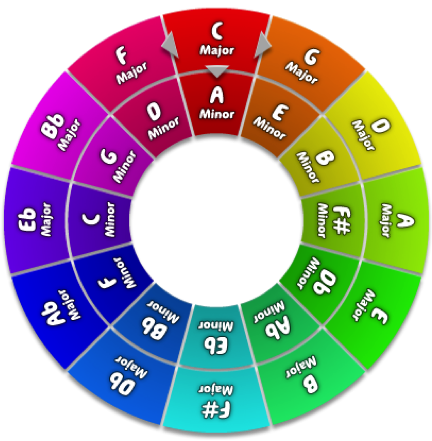 If one isn’t musically educated one might find it difficult to remember how keys associate themselves in a musical scale but the developers of the Mixed in Key software developed the Camelot wheel which makes it easier visually to understand the key relations .
Keyscale accordding to the camelot wheel
Camelot wheel tagged in Mixed in Key
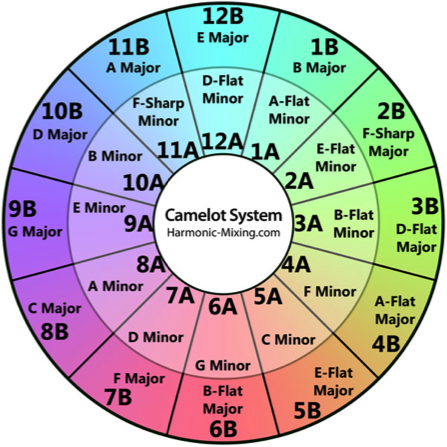
On theses wheels, musical keys can be seen as "hours" on a clock. For example, 4 o'clock corresponds to 4B or 4A. The letter "B" represents Major keys. The letter "A" represents Minor keys.
To use harmonic mixing in your DJ sets, you can change keys with every mix by moving around the Camelot wheel one step at a time. Mix between songs by subtracting one hour (-1), adding one hour (+1), or staying in the same hour as your last song. So if you're playing a song tagged 4A, your next track can be 3A, 4A or 5A.
For a special effect, you can mix between the inner circle and outer circle. For example, mix from 4A to 4B.
Click to see more info onthis course where this was extracted from...


